The people of Atuabo and Sanzule celebrated following the announcement of the construction of gas processing plants. They expected the gas industry to bring jobs and increase their standard of living. Years later, they wish gas had never been discovered in their regions. Farmers and fishermen have lost their livelihoods. Many have had to leave home.
Here, Augustine Kaku provides an analysis of the words that farmers, fisherman, and families use to explain their disappointments and difficulties in the Ellembelle district.
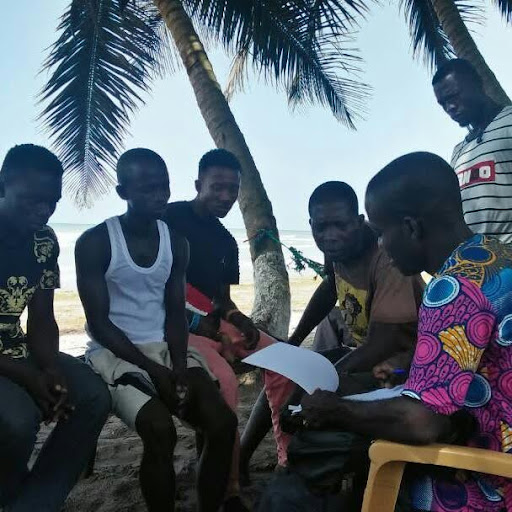
Frontiers of Belonging International Research Training Group member Augustine Kaku talks with a focus group of fishermen in Sanzule
Natural resource discovery in developing regions usually nourishes hopes of economic growth, job creation, and improved infrastructure. In reality, it often introduces socio-economic and environmental challenges, including the disruption of livelihoods, followed by displacement. Farmers and fishermen in the Atuabo and Sanzule communities of Western Ghana are no exception. Having first embraced the discovery of oil and gas, over time, they came to realise its long-term destructive impact on their daily lives.
Oil and gas production requires extensive land acquisition, as was the case when the Ghanaian government, in consultation with Ghana Gas, the Ghana National Petroleum Corporation (GNPC) and various stakeholders, built a gas processing plant at Atuabo and Sanzule, both in the Ellembelle district of the Western Region.
Local farmers in Atuabo and Sanzule were poorly compensated for the land the gas processing plants acquired. Many lost unharvested crops, increasing their economic vulnerability. Anyima, a local farmer, says:
I never expected this to happen in our communities that a day will come when our lands will be taken away from us. They took away our land but paid us so small. When we complained, they said we don’t have papers on our land.
Atuabo Miezah explains the local norms that previously structured access to land:
Land in these areas was not sold. All one needed to do was to present a bottle of gin to the head of the family or the owner of the land. Sometimes a little amount to fulfill tradition was added to it.
Miezah also explains the long-term effects of the loss of land:
Today, land is very expensive here because the gas companies have taken our land from us and they never paid us too. This has forced some people out of here.
Avola in Sanzule explains that the loss of land has introduced economic hardship in households, splitting families:
They took the land from our husbands. Women in these areas usually don’t own lands but rely on men or husbands for their livelihoods. The ENI Gas took the land from us and we are suffering here. My husband is no longer living here because he has no job. This is not good for us.
Local farmers in Atuabo and Sanzule who cannot cope with severe land shortages have been compelled to find alternative livelihoods elsewhere.
When questioned about land expropriations, an officer at Ghana Gas at Atuabo explained:
You see, this is a company and we deal with documents. The problem with this part of the country is that many landowners do not have papers on their lands and assets. We cannot pay them without papers covering their land. We love them and want to help them.
In this region of Ghana, many lands are not individually owned but rather belong to an entire lineage. These socio-legal norms, combined with a lack of resources and unfamiliarity with bureaucratic processes, have made Atuabo and Sanzule land owners reluctant or unable to obtain freehold titles for their land, facilitating oil and gas companies’ acquisition of property.
Fishermen in Atuabo and Sanzule lost access to traditional fishing areas after gas processing began. Egya Ackah, a local fisherman, describes how oil and gas activities have affected the region:
I thought Ghana’s oil and Gas would bring us happiness, but it has rather brought us sadness and loss of jobs. In time before Ghana discovered oil, we had plentiful fish harvest to the extent that small fishes were left on the field because we knew we would get more the next day. It brought us money, but today, when we go fishing, we catch nothing, only rubbish. Some people have migrated out of here.
The fishing business no longer provides the income it made before the discovery of oil and gas, as Yaba recounts:
I never dreamt this misfortune would happen to us one day, that a day would come when fish harvest would go so low. It is shocking to me. I am sure if someone from the living goes to tell our ancestors that we no longer get fish as we used to, they will not believe him or her.
The Ellembelle population once believed that oil exploration would bring industry jobs to residents. However, research shows that extractive industries often create fewer jobs than anticipated. Most skilled positions go to expatriates or urban elites. In Atuabo and Sanzule, a lack of formal education and technical skills are barriers to local populations securing employment in the oil sector. As Anyima says,
The oil and gas activities in these communities have not done any good to us at all. The officials in these companies don’t listen to our opinions, they don’t employ people from here, when we ask them to employ our people, they say we don’t have the skills to work with them. I disagree with them. What about driving, cooking, cleaning or labourer work, can’t our people do them? They have just decided not to help us.
An Officer with the ENI Gas insists that the company provides jobs, support services and other benefits to the surrounding communities:
Since our establishment here, we have provided a lot of help and assistance to the surrounding communities. These include provision of employment, livelihood benefits, food supply, provision of portable water and sanitary services. Others are transport services, renovation of chief palaces in various places and preparation of food by some caterers.
In the wake of oil and gas extraction, dispossession, declining fish harvests, and unfulfilled employment expectations have disrupted the communities of Atuabo and Sanzule, leaving them in economic distress. Many have migrated elsewhere in search of alternative livelihoods.
To mitigate these impacts, governments and oil companies must:
- Ensure fair and transparent compensation mechanisms, including alternative land allocations for affected farmers.
- Invest in vocational training and formal education to enhance employability within and beyond the oil sector.
- Foster alternative livelihoods such as agro-processing, small-scale enterprises, and non-farm employment to reduce dependency on extractive industries.
To learn more, please refer to the longer paper by Augustine Kaku, “Socio-Economic Impact of Oil and Gas Discoveries on Atuabo and Sanzule in the Ellembelle District,” Social Sciences & Humanities Open (2025): https://papers.ssrn.com/sol3/papers.cfm?abstract_id=5113215