Deepening divides in Ghanaian politics reveal the legacy of a pervasive fear of political persecution that emerged in the 1960s, in contrast with aspirational ideas of unity, justice and freedom at the beginning of the African independence era.
In this post, Gloria is on a path to recover a view from the Ghanaian margins – the marginalized voices of the Ghana Young Pioneers, whose wings got singed when they flew too close to the fires of political struggle.
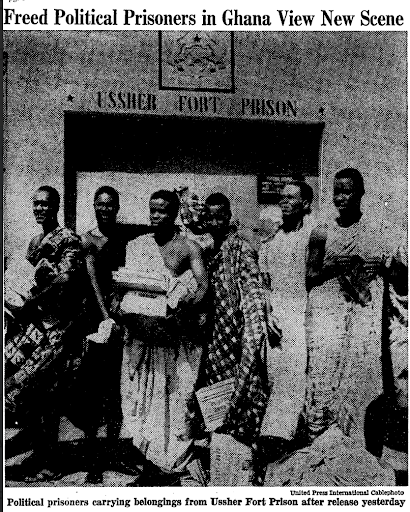
LLOYD GARRISON Special to The New York Times; Feb 27, 1966; pg. 1 shows the release of hundreds of political prisoners from the Fort Usher prison. Accessed from the ProQuest Historical Newspapers.
On February 25, 1966, a day after the overthrow of Ghana's first president, Kwame Nkrumah, the New York Times reported the release of about four hundred political prisoners from the Fort James and Usher prisons. Thousands of weeping relatives and cheering anti-Nkrumah demonstrators flooded the streets of Accra. In a national radio and television broadcast, the new regime announced that the regime change would “restore to the people of Ghana the blessings of liberty, justice, happiness, and prosperity for which we all have struggled for so long.” The new pro-West National Liberation Council (NLC) would usher in the American ‘value of freedom.’
But it was not freedom for all. After the 1966 coup, the NLC questioned the belonging of young nationalists--many of whom were members of the Ghana Young Pioneer Movement, Ghanaian returnees, and student migrants from the Soviet Union—by characterizing them as threatening outsiders.
1960s-era Cold War dynamics influenced national belonging in Ghana after Nkrumah. In 1966, the new regime targeted the Ghana Young Pioneers Movement, a pan-African youth organization that Kwame Nkrumah had established in the 1960s, to instil patriotic and socialist values in Ghanaian youth as part of its efforts to eliminate Nkrumahism and communism.
In its report of Nkrumah’s overthrow, the Soviet newspaper, Pravda, shed light on anti-communist practices in the wake of the coup. At Ghana’s airport, policemen and curious civilians asked “foreigners” if they were Russian. When the foreigners identified themselves as Americans, onlookers chanted, “Okay – USA.!” Near Ghana’s parliament house, where a statue of Nkrumah lay in ruins, a crowd of more than a thousand chanted, “No more Kwame! No more Russian!” These political expressions defined who belonged in a Western-era Ghana that had no place for communism or anything associated with it. The NLC used anti-Nkrumahist propaganda to create a homogenous political community, which alienated people associated with the Communist East and Nkrumah from the polity.
Recent interviews with former Ghana Young Pioneers and other senior citizens who experienced the events of the 1960s unveil long-silenced truths about political persecutions that forced supporters of the Nkrumah regime into hiding. These stories reveal how past traumas have contributed to omissions from collective memory. Fred, a resident of the Nima community in Accra and former Young Pioneer, recounts how, a few days after the coup, his father gathered items associated with the Ghana Young Pioneers or Nkrumah and buried them. Others tell of widespread destruction of Pioneer archives after the coup. In the absence of archival records, oral testimonies are especially important, as are songs, gossip, and rumours. Using oral sources to produce a politically contested history presents a challenge for historians. These sources can seem vague, unreliable, or untrue... mere background noise in “real” history. Yet, the stories of the Ghana Young Pioneers are essential to the reconstruction of Ghana’s past, especially now as politicians grapple with how to commemorate the Nkrumah era.
The process of historicization of key events in Ghana’s post-independence era remains in the memory of a generation that is still alive. Their lived experiences become part of a historical narration. However, as a result of the formation of a heroic and united nationalist history, both individual and collective memories—particularly those of grassroots movements like the Ghana Young Pioneers—often exist on the periphery. Even so, fragmented memories enhance our construction of the past, filling the gaps between various historical sources, such as archives and oral testimonies. Analysis of rumors and gossip following the coup shows how deeply exclusion became entrenched in Ghana after Nkrumah. The lingering trauma of exclusion continues to shape public memory because the stories of those excluded have mostly gone unheard.
The memory of Nkrumah’s overthrow is a flashpoint for contemporary political identity and policy. As one example, on February 24, 2025, a statement commemorating the anniversary of the 1966 coup announced a lawsuit filed at Ghana’s Supreme Court challenging the country’s International Airport name that honors Lieutenant-General Emmanuel Kwasi Kotoka, a pivotal figure in the coup d’état. For the opposition Convention People’s Party leaders spearheading the legal case, the name undermines Ghana’s democratic values.
The oral testimony of former Pioneers offers an opportunity to address the past exclusionary practices linked to the coup and to reflect on Ghana’s reintegration policies for a more equitable political landscape. Thinking historically about belonging after regime change requires including historical accounts that are not yet part of official state history.
To learn more, please refer to the longer paper by Gloria Lamptey, “Liberation from Below: Grassroots Notions of Decolonization in Africa,” Historically Modern, Open (2025): https://www.historicallymodern.ca/post/liberation-from-below